
Miles to Steps Calculator : How Many Steps Are in a Mile?
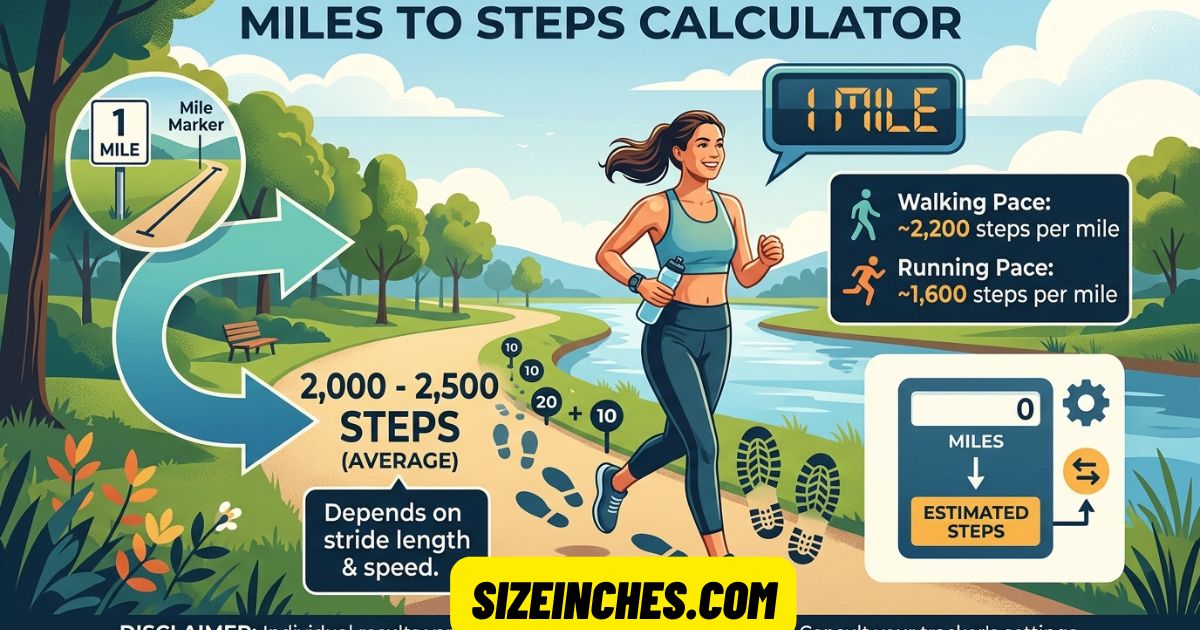
A “miles to steps calculator” turns a walking distance into a step count. One mile equals about 2,000 to 2,500 steps for most adults. The average sits near 2,200 steps, though your height and pace change that number.
Have you ever finished a walk and wondered how many steps you took? A simple number can tell you, even without a fitness tracker. Once you learn it, you can turn any distance into steps in your head.
Taller people take longer strides, so they need fewer steps per mile. A runner covers a mile in about 1,400 to 1,700 steps. The popular 10,000-step daily goal equals roughly 4.5 miles of walking.
Miles to Steps in Different Units
One mile equals 5,280 feet, or about 1.61 kilometers. Divide that by an average walking stride of about 2.5 feet (76 cm), and you get roughly 2,112 steps per mile. Most people land between 2,000 and 2,500 steps, so treat these as close approximate figures.
| Unit | Equivalent | Notes |
| 1 mile | 5,280 feet | The base figure |
| 1 mile | 1.61 km | Metric conversion |
| 1 mile | 1,760 yards | Imperial conversion |
| 1 mile (walking) | ~2,000–2,500 steps | Varies by height and pace |
| 1 mile (average) | ~2,200 steps | A solid middle estimate |
| 1 mile (running) | ~1,400–1,700 steps | Longer stride, fewer steps |
| 1 step (walking) | ~2.1–2.5 ft / 64–76 cm | An average adult stride |
| 1 km | ~1,250–1,550 steps | About 1,370 on average |
Quick Reference: Steps Per Mile by Height
Taller people take longer strides, so they need fewer steps to cover a mile. This chart gives close estimates for walking at a normal pace. Every figure is approximate, since stride length varies from person to person.
| Height | Approx. Steps per Mile | Stride Length | Best For |
| 5’0″ (152 cm) | ~2,500 steps | ~2.1 ft | Shorter walkers |
| 5’2″ (157 cm) | ~2,440 steps | ~2.16 ft | Shorter walkers |
| 5’4″ (163 cm) | ~2,370 steps | ~2.23 ft | Below-average height |
| 5’6″ (168 cm) | ~2,300 steps | ~2.3 ft | Average height |
| 5’8″ (173 cm) | ~2,230 steps | ~2.37 ft | Average height |
| 5’10” (178 cm) | ~2,170 steps | ~2.43 ft | Above-average height |
| 6’0″ (183 cm) | ~2,110 steps | ~2.5 ft | Taller walkers |
| 6’2″ (188 cm) | ~2,050 steps | ~2.57 ft | Taller walkers |
| 6’4″ (193 cm) | ~1,990 steps | ~2.65 ft | Tallest walkers |
| Running (any height) | ~1,400–1,700 steps | ~3.1–3.8 ft | Runners and joggers |
15 Real Distances That Equal About a Mile of Steps
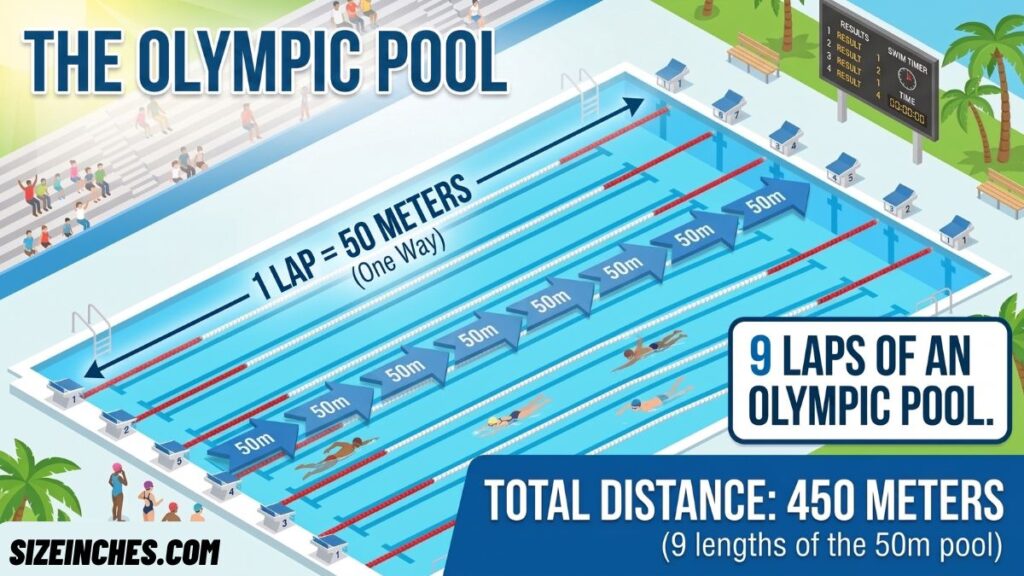
About 9 Laps of an Olympic Swimming Pool
READ ALSO : What Weighs 1 Gram? Everyday Objects to Picture It
Walking the length of an Olympic swimming pool about 32 times covers a mile. Each pool measures 50 meters long, so 32 lengths come to 1,600 meters, or about 0.99 miles. That’s roughly 2,200 steps for an average walker. If you count full laps down and back, you’d need about 16 of them.
Olympic pool size is fixed by international rules, which is why every one measures the same. The pool holds ten lanes, each 2.5 meters wide, and runs about 2 meters deep for competition. Swimmers cover far more distance per stroke than a walker does per step. Since pools are common at gyms and schools, counting lengths gives you a clean, measured way to picture a mile.
About 4 Times Around a Soccer Field
Walking the full perimeter of a soccer field about 4 times covers roughly a mile. A standard pitch runs about 110 by 70 yards, so one lap around the edge is close to 360 yards. Four laps come to 1,440 yards, a bit under a mile. Add a fifth partial lap and you’d hit 2,200 steps.
Soccer field size varies more than most sports fields, with FIFA allowing a range rather than one fixed number. Pro pitches often run 115 by 74 yards, while youth fields are smaller. The touchlines are always longer than the goal lines. Since soccer fields sit in parks and schools everywhere, walking the perimeter is a handy way to log a measured mile.
About 21 Basketball Courts End to End
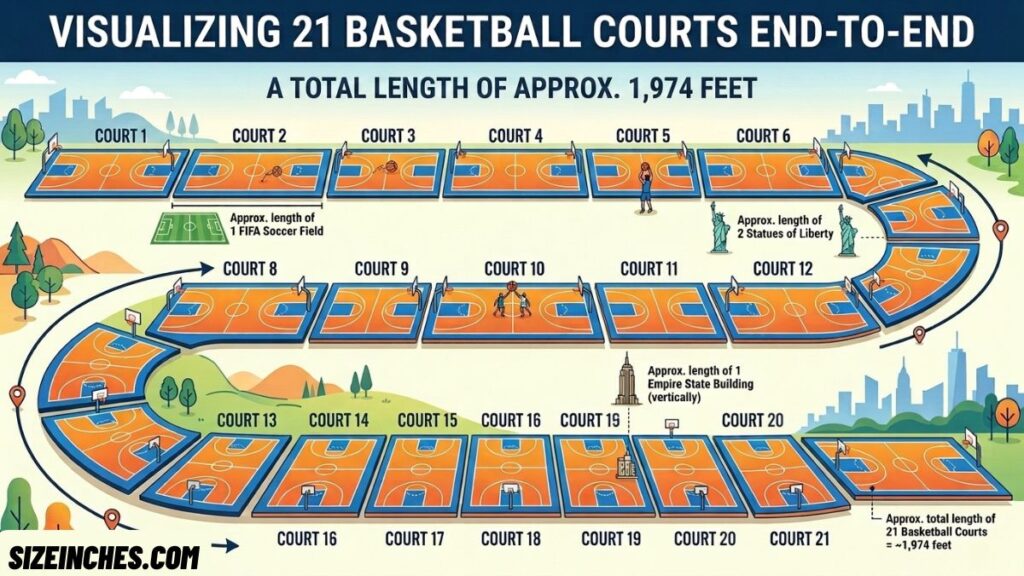
About 21 basketball courts laid end to end equal a mile. A regulation NBA court measures 94 feet long, so 21 of them come to 1,974 feet. You’d actually need about 56 courts to reach 5,280 feet, which is roughly 2,200 steps. Walking the length of one court takes about 40 steps.
Court size is set by league rules, though college courts match the NBA at 94 feet and high school courts run shorter at 84 feet. The hardwood surface is usually maple, chosen for its tight grain and spring. Since gyms are everywhere, counting court lengths is a simple way to break a mile into small, countable pieces you can actually track.
About 3 Times Around a Typical Shopping Mall Loop
Walking the full inner loop of a large shopping mall about 2 to 3 times covers a mile. A big two-level mall often has a loop near half a mile per level. So two or three circuits get you to 2,200 steps. Many malls even post walking distances for early-morning mall walkers.
Mall loop length varies a lot by size and layout, which is why this is a range. Some malls run long, straight corridors, while others wind around courtyards. Mall walking became popular because the climate stays steady and the floor is flat and safe. If your local mall posts its loop distance, you’ve got a reliable, weatherproof mile you can walk year-round.
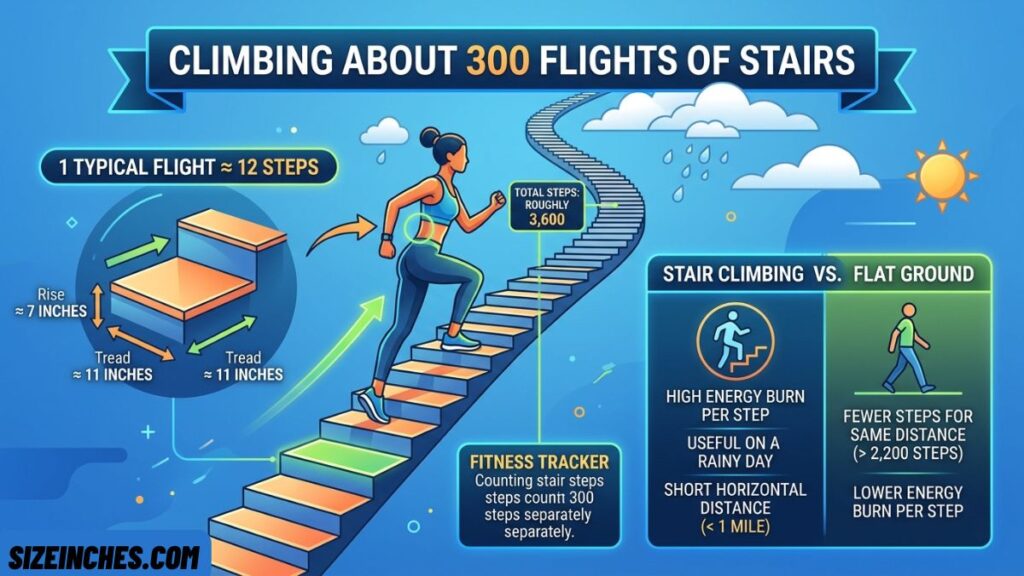
Climbing About 300 Flights of Stairs
READ ALSO : iPhone Wallpaper Size (2026): The Exact Pixels for Every Model
Climbing stairs isn’t the same as walking flat ground, but the step math still helps. A typical flight holds about 12 steps, so 300 flights come to roughly 3,600 steps. Since stair steps are shorter than walking strides, you’d cover far less horizontal distance than a mile, though your step count would exceed 2,200.
Standard stair rise sits near 7 inches per step, with a tread depth around 11 inches. Building codes set these limits so stairs feel safe and even underfoot. Climbing burns more energy per step than flat walking, which is why fitness trackers often count stair steps separately. Stairs give you a high step count in a small space, useful on a rainy day.
About 8 Trips Around a Standard Tennis Court
Walking the perimeter of a tennis court about 28 times covers a mile. A doubles court measures 78 by 36 feet, so one lap around the edge is 228 feet. Twenty-eight laps come to 6,384 feet, more than a mile, while about 23 laps hits 5,280 feet, or roughly 2,200 steps.
Tennis court size is set by the sport’s governing bodies and never changes. A singles court is narrower at 27 feet wide, since the doubles alleys sit outside the singles lines. The surface may be hard court, clay, or grass, each of which changes how the ball bounces. Counting court laps is a simple way to log a measured mile at a local park.
About 4 Times the Length of the Golden Gate Bridge Deck
Walking across the Golden Gate Bridge and back covers most of a mile. The main span stretches about 4,200 feet, and the full bridge length runs near 8,980 feet, or about 1.7 miles. So a single crossing of the main span comes to roughly 0.8 miles, or about 1,750 steps.
The bridge opened in 1937 and held the record as the world’s longest suspension span for nearly 30 years. Its sidewalks are open to walkers during daylight hours, and the crossing is a popular tourist walk. The famous orange color, called International Orange, was chosen to stand out in fog. Crossing it gives you a memorable, measured stretch of walking.
Four Laps of a Running Track
Four laps of a standard running track equal about 1 mile. A regulation outdoor track measures 400 meters per lap in the inside lane, so four laps come to 1,600 meters, or about 0.99 miles. That’s roughly 2,200 steps for an average walker. It’s the most exact real-world way to picture a mile of walking.
Tracks follow a global standard set for competition, which is why every one measures the same. Runners often call four laps “a mile,” though it’s technically about 9 meters short. The outer lanes are longer, so walking in lane 1 keeps you closest to the true distance. If you have a school or park track nearby, four laps give you a reliable, repeatable mile
About 20 City Blocks in Manhattan
Roughly 20 north-south blocks in Manhattan equal about 1 mile. Each short block runs about 264 feet, so 20 of them come to 5,280 feet, an exact mile. That’s near 2,200 steps at an average stride. If you’ve ever walked from 42nd Street to 62nd Street, you’ve walked a mile.
Manhattan’s grid was laid out in 1811, and the block spacing has stayed steady ever since. The long east-west blocks are a different story, running about three to four times longer, so only about five of those make a mile. Block size varies a lot in other cities, which is why Manhattan is the classic reference. Twenty short blocks give you a clean, walkable mile.
About 17.5 Football Fields
About 17.5 American football fields laid end to end equal 1 mile. A full field, including both end zones, measures 360 feet (120 yards). So 17.6 fields come to 5,280 feet, an exact mile. That’s roughly 2,200 steps for an average walker.
Football field size is fixed by league rules, which is why the number stays steady. The playing field is 100 yards, with two 10-yard end zones added on. Since so many people know a football field on sight, this is one of the easiest ways to picture a mile. Walking the length of a field takes about 125 steps, so it’s a handy unit for breaking a mile into chunks.
A 15 to 20 Minute Walk
A 15 to 20 minute walk at a normal pace covers about 1 mile. Most adults walk at roughly 3 miles per hour, which works out to a mile every 20 minutes. A brisk walker at 4 mph covers a mile in about 15 minutes. Either way, you’d log close to 2,200 steps.
Walking speed shifts with age, fitness, and terrain, so this one is a range. A stroll may take 25 minutes, while a fast walk can dip under 14. Hills, crowds, and traffic lights all slow you down. Time is a useful mile-marker when you have no tracker or map. Just glance at your watch, walk a steady pace, and you’ll know roughly how far you’ve gone.
Four and a Half Times Around a Baseball Diamond
Walking the bases about 58 times covers a mile, but a lap around the outfield warning track is more useful. The bases form a square with 90 feet per side, so one full lap is 360 feet. You’d need about 14.7 laps of the bases to reach a mile, which comes to roughly 2,200 steps.
Baseball field size is set by the rules, with 90 feet between bases in the pro game. Little League uses 60 feet instead. The infield square is called the diamond, though it’s really a square turned on its point. Since ballfields are common in parks, counting base laps is a fun way to break a mile into small, countable chunks.
Half a Lap Around a Large Reservoir Path
Many park loop paths run between 1.5 and 1.6 miles, so a bit more than half a lap equals a mile. The Central Park Reservoir loop, for example, measures about 1.58 miles. Walking two-thirds of it gets you to a mile, or roughly 2,200 steps.
Loop path lengths vary a lot from park to park, which is why this is approximate. Many parks post the distance on a sign at the trailhead, so check before you count. Loop paths are popular because you always end where you started, and the flat surface keeps your stride steady. Once you know your local loop’s length, it becomes a simple, repeatable mile marker.
About 5,280 Feet of Sidewalk
A mile is exactly 5,280 feet, or 1,760 yards. Standard sidewalk squares often measure about 5 feet across, so roughly 1,056 squares make a mile. That’s close to 2,200 steps for an average walker, since most people cover about two squares in a little over two steps.
Sidewalk square size varies by city and by the year it was poured, so this is a rough guide. Concrete slabs are cut with control joints to let the material expand and crack neatly rather than randomly. Counting squares gets tedious over a full mile, but it’s handy for short distances. It also gives you a real sense of just how long 5,280 feet actually is.
A Quarter of Your Daily 10,000 Steps
The popular 10,000-step daily goal equals about 4.5 miles of walking. So one mile is roughly a fifth to a quarter of that target, at about 2,200 steps. If you hit 2,200 steps, you’ve walked a mile and knocked out over a fifth of the daily goal.
The 10,000-step target began as a marketing slogan for a Japanese pedometer in the 1960s, not a medical finding. Research since then suggests real health benefits start well below that number, often around 7,000 to 8,000 steps a day. Still, it’s a useful mental anchor. Thinking in miles rather than raw steps often makes a walking goal feel far more achievable.
How to Count Steps in a Mile Without a Tracker
No fitness watch or phone app? These methods get you a solid step count using only what’s around you.
Measure Your Own Stride Length
This is the most accurate method. Mark a straight line of 20 feet on the ground. Walk it at a normal pace and count your steps. Then divide 20 by your step count to get your stride length in feet. Now divide 5,280 by that number, and you have your personal steps per mile. It beats any generic chart.
Use Time and Pace
Walking speed gives you a close estimate. Most adults walk about 3 mph, or a mile every 20 minutes. Multiply your walking minutes by three to get a rough count of hundreds of steps, since an average walker takes about 100 steps per minute. So a 20-minute walk lands near 2,000 steps, close to one mile.
Count Laps on a Known Distance
Find a distance you already know, like a 400-meter track or a marked park loop. Walk one lap and count your steps. Then multiply to reach a mile. Four track laps come to about 0.99 miles, so your total lap count times four gives you a solid steps-per-mile figure. It’s simple, repeatable, and needs no gear.
Miles to Steps vs. Other Common Distances
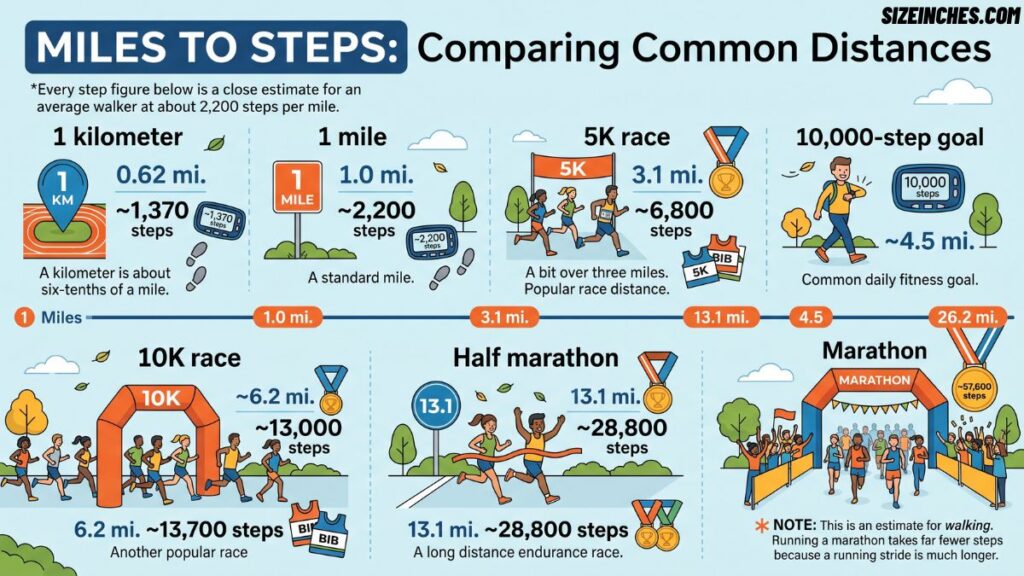
Seeing a mile next to other distances helps it click. Every step figure below is a close estimate for an average walker at about 2,200 steps per mile.
| Distance | In Miles | Approx. Steps (Walking) |
| 1 kilometer | 0.62 mi | ~1,370 steps |
| 1 mile | 1.0 mi | ~2,200 steps |
| 5K race | 3.1 mi | ~6,800 steps |
| 10,000-step goal | ~4.5 mi | 10,000 steps |
| 10K race | 6.2 mi | ~13,700 steps |
| Half marathon | 13.1 mi | ~28,800 steps |
| Marathon | 26.2 mi | ~57,600 steps |
A kilometer is about six-tenths of a mile, so it takes roughly 1,370 steps. A 5K comes to about 6,800 steps, or a bit over three miles. The 10,000-step daily goal works out to around 4.5 miles of walking. A full marathon runs about 57,600 walking steps, though runners cover it in far fewer, since a running stride is much longer.
Frequently Asked Questions
How Many Steps Is 1 Mile?
One mile equals about 2,000 to 2,500 steps for most adults, with 2,200 as a solid average. Your height and pace change the number.
How Many Miles Is 10,000 Steps of Walking?
Ten thousand steps equals about 4.5 miles of walking. The exact distance ranges from 4 to 5 miles, depending on your stride length.
Is 5000 Steps 2.5 Miles?
Close, but a little high. Five thousand steps is about 2.3 miles for an average walker, with a range of roughly 2 to 2.5 miles.
What Would 20,000 Steps Be in Miles?
Twenty thousand steps equals about 9 miles of walking. The range runs from 8 to 10 miles, depending on your height and stride.
Can I Walk 20k Steps in 2 Hours?
Very unlikely. Most walkers take about 100 steps per minute, so 20,000 steps needs roughly 3.5 hours. Two hours would demand a near-jogging pace.
How many steps should I walk a day?
Research suggests real health benefits begin around 7,000 to 8,000 steps a day, though more is generally better. The famous 10,000-step goal started as a 1960s pedometer slogan, not a medical finding. That target equals about 4.5 miles. Any consistent daily walking helps, so start where you are.
Conclusion
Now you know how a miles to steps calculator works. One mile equals about 2,000 to 2,500 steps for most adults. The average sits near 2,200 steps. Your height and pace change that number. Taller people take longer strides, so they need fewer steps. A runner covers a mile in about 1,400 to 1,700 steps. These simple figures help you turn any distance into steps.
You can also picture a mile with real places. Four laps of a running track equal about one mile. Twenty short city blocks match it too. A steady 20-minute walk covers the same ground. Measure your own stride once, and you will always know your exact steps per mile.






One Comment