2 mm Visual: How Big Is 2 mm, Really?
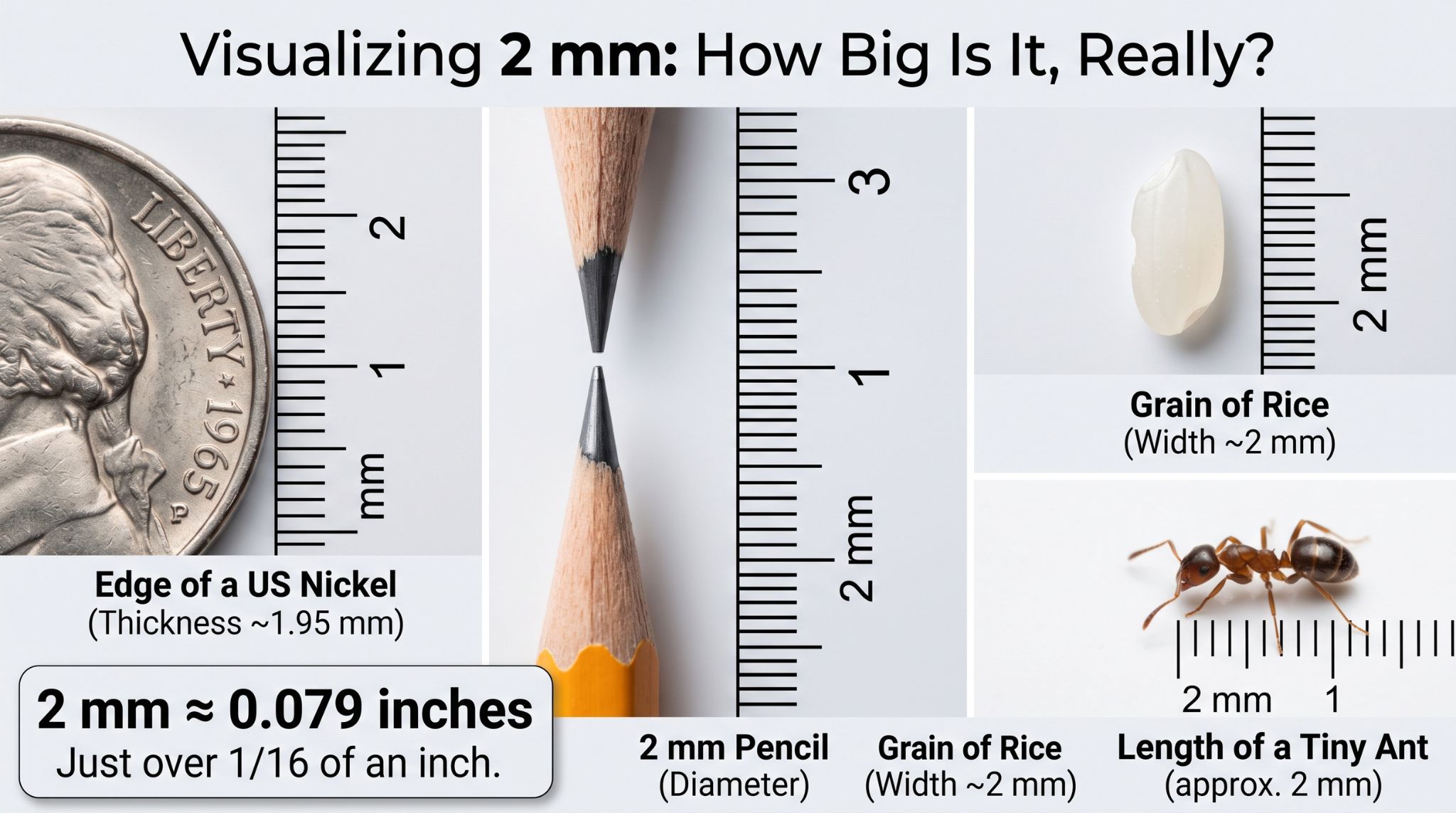
A “2 mm visual” means picturing how big 2 mm really is. Two millimeters equals about 0.079 inches, or just over 1/16 of an inch. That is a small length, close to the thickness of a US nickel.
Have you ever read a size online and struggled to picture it? A quick visual makes any measurement clear. Once you know a few objects, you can judge 2 mm by eye with ease.
You can find 2 mm all around you. A nickel’s edge and a 2 mm pencil lead both match it well. A grain of rice is about 2 mm wide too.
2 mm in Different Units
Two millimeters equals about 0.079 inches, or just over 1/16 of an inch. In metric, that’s 0.2 centimeters or 2,000 microns. It’s a small length, thicker than a coin’s edge but thinner than a pencil. Here’s the full breakdown so you can convert it fast.
| Unit | Equivalent | Notes |
| Millimeters | 2 mm | The base figure |
| Centimeters | 0.2 cm | One-fifth of a cm |
| Inches | 0.079 in | Just over 1/16 inch |
| Fraction (inch) | ~5/64 in | Closest simple fraction |
| Microns | 2,000 µm | Handy for fine work |
| Points (print) | ~5.67 pt | Used in typography |
| Pixels at 96 DPI | ~7.6 px | Screen measurement |
Quick Reference Table
Here are common objects about 2 mm thick or wide, or close to it. Some match exactly, and some are a rough guide. The table is honest about which is which.
| Item | Exact or Approx. | Visual / Notes | Best For |
| US nickel (thickness) | 1.95 mm | Almost exactly 2 mm | Thickness |
| 2 credit cards stacked | ~1.7 mm | Just under 2 mm | Thickness |
| Nickel + dime stacked | ~3.3 mm | A bit over 2 mm | Rough guide |
| Standard pencil lead (2 mm) | 2.0 mm | Exact match | Width |
| 2 dimes stacked | ~2.7 mm | A touch over 2 mm | Rough guide |
| Grain of rice (width) | ~2 mm | Close match | Width |
| Two stacked business cards | ~1.6 mm | Just under 2 mm | Thickness |
| Guitar pick (medium) | ~0.7 mm | Thinner than 2 mm | Contrast |
| Toothpick (thickness) | ~2 mm | Close match | Thickness |
| Sesame seed (length) | ~3 mm | A bit bigger | Rough guide |
12 Everyday Things That Are 2 mm
A US Nickel’s Thickness
READ ALSO : Average Living Room Size: Typical Dimensions Explained (2026)
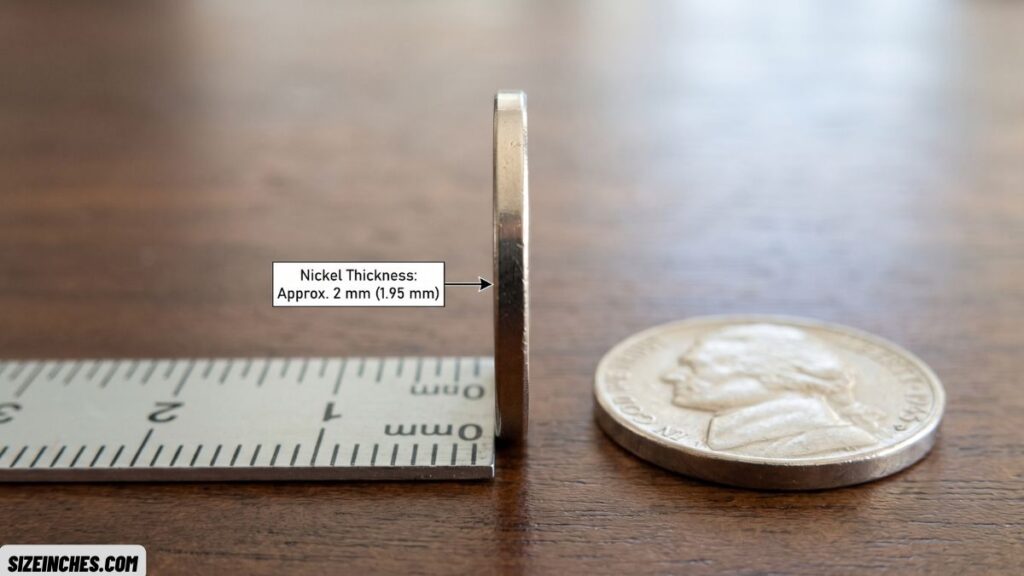
A US nickel is almost exactly a 2 mm visual. The coin measures 1.95 mm thick, just a hair under 2 mm. Hold a nickel on its edge and you’re looking at very close to 2 mm. Since nickels are easy to find, it’s the best everyday reference for the length.
The US Mint sets the nickel’s size by law, which is why the thickness never changes. Every nickel is 75% copper and 25% nickel, giving it a solid feel. The coin’s edge is smooth, unlike a dime or quarter, which have ridges. If you ever need to picture 2 mm, a nickel’s thickness gives you a spot-on, pocket-sized guide you can check by hand.
A 2 mm Pencil Lead
READ ALSO : Zyn Can Dimensions: How Wide and How Tall Is the Can?
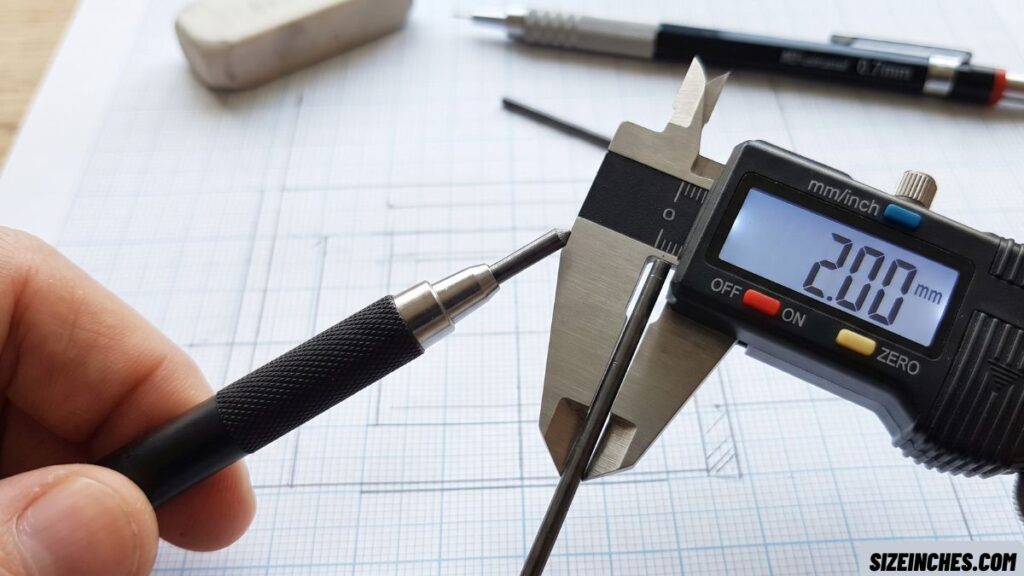
A 2 mm pencil lead is an exact match for the length. Mechanical pencils that use 2 mm leads hold a refill exactly that wide. Look at the lead sticking out of the tip, and you’re seeing a true 2 mm. It’s a precise reference, since the lead is made to that size on purpose.
Pencil leads come in several widths, from thin 0.5 mm to thick 2 mm. The 2 mm size is used in lead holders and older drafting pencils, prized for strong, bold lines. The “lead” is actually graphite mixed with clay, not real lead. A 2 mm lead gives you an exact, easy way to picture the width, especially if you sketch or draft.
A Standard Staple’s Wire
A standard staple is close to a 2 mm visual in a few spots. The wire itself is thin, but the flat crown and the leg gauge sit near 2 mm in width on common office staples. Look at the top bar of a staple, and its width is close to 2 mm. Since staples are in most desks, it’s an easy reference to find.
Staple size varies by type, so treat this as approximate. A standard No. 24/6 staple has legs about 6 mm long, with a crown near 12 mm wide. The wire gauge measures around 0.5 mm, while stacked features reach toward 2 mm. Staples are made from thin steel wire, coated to resist rust and slide through paper. A staple gives you a close, everyday feel for small millimeter lengths near 2 mm.
A Peppercorn
A whole peppercorn is close to a 2 mm visual, though a bit bigger. A typical black peppercorn measures about 3 to 5 mm across, so a small one comes closer to the 2 to 3 mm range. Look at a single peppercorn, and you’re near the length, especially a smaller grain. Since pepper is in most kitchens, it’s an easy reference to grab.
Peppercorn size varies by type and grade, so treat this as approximate. Small peppercorns run near 3 mm, while large ones top 5 mm. Peppercorns are dried berries from the pepper plant, picked before they ripen. They’re sold whole for grinding fresh. A small peppercorn gives you a rough, everyday guide for a length near 2 mm, handy when sizing up tiny objects.
A Ballpoint Pen Tip
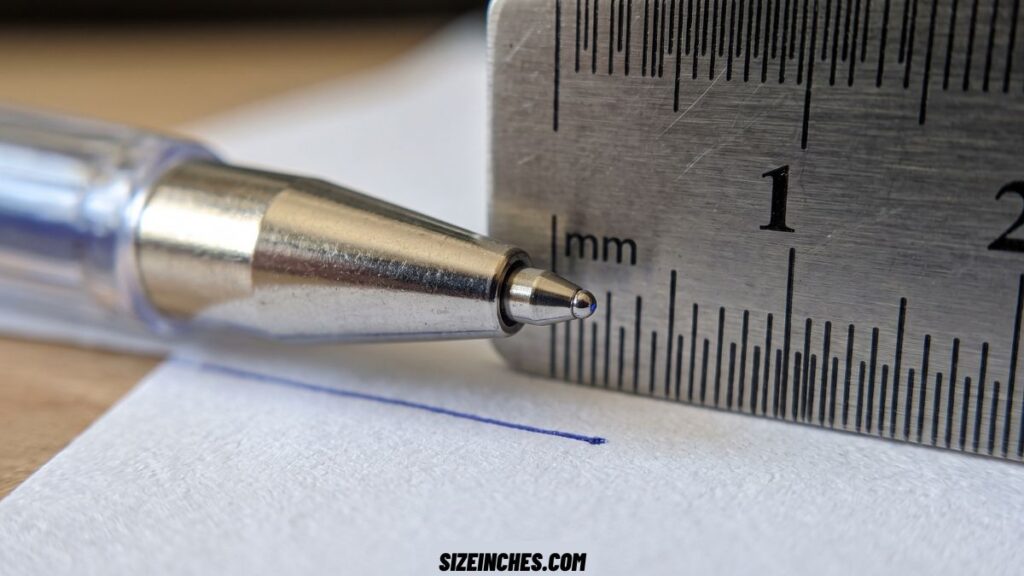
A ballpoint pen tip is close to a 2 mm visual at its widest. The metal cone that holds the ball measures about 2 mm across near its base, tapering to the tiny rolling ball. Look at the pen tip, and the widest part is near 2 mm. Since almost everyone has a pen, it’s one of the easiest references to grab.
Pen tip size varies by style, so treat this as approximate. The writing ball itself is tiny, often 0.5 to 1 mm, while the metal housing around it runs wider. The tip is made from brass or steel, holding a hard rolling ball that spreads ink. The base of a pen tip gives you a close, everyday feel for 2 mm, easy to check by eye.
A Matchstick’s Thickness
A wooden matchstick is close to a 2 mm visual in thickness. The square wooden stick measures about 2 to 2.5 mm across, right near the length. Look at a matchstick end-on, and its width is close to 2 mm. Since matches are common in many homes, it’s an easy reference to grab and picture.
Matchstick size varies by brand, so treat this as approximate. A slim match runs closer to 2 mm, while a thick fireplace match is wider. The stick is made from soft wood, dipped in a coating that lights when struck. The wood is often treated so it stops glowing after the flame goes out. A matchstick gives you a close, everyday guide for 2 mm, easy to check by hand.
Two Credit Cards Stacked
Two credit cards stacked are close to a 2 mm visual. Each card is about 0.76 to 0.84 mm thick, so two together come to roughly 1.7 mm, just under 2 mm. Stack two cards and pinch the edge, and you’re near the length. Since most people carry cards, it’s an easy reference to grab.
Credit and debit cards follow a worldwide standard called ID-1, which sets the thickness at about 0.76 mm. That uniform size lets every card fit the same wallet slot and reader. The cards are made from layered plastic with a chip inside. Two cards fall a bit under 2 mm, while three come to about 2.5 mm. Two stacked cards give you a close, everyday guide for the length.
A Grain of Rice
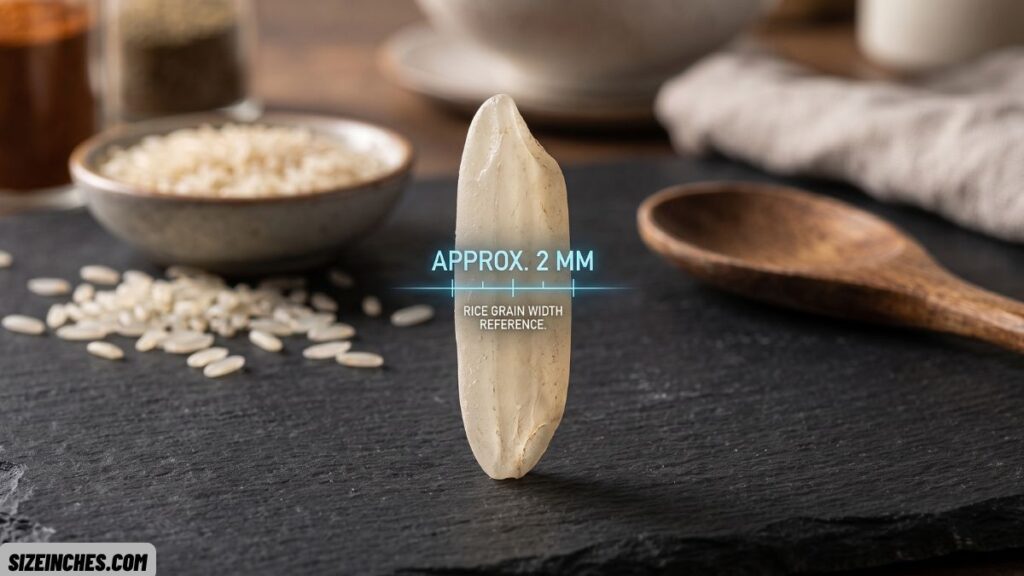
A grain of rice is close to a 2 mm visual across its width. A typical grain measures about 2 mm wide, though it runs longer at 6 to 7 mm. Look at a grain from the end, and its width is near 2 mm. Since rice is in most kitchens, it’s an easy reference to grab and picture.
Rice grain size varies by type, so treat this as approximate. Long-grain rice is slimmer, while short-grain and round types are a bit wider. Rice is the seed of a grass plant, grown in flooded fields across much of the world. The width of a single grain gives you a close, everyday feel for 2 mm, handy when no ruler is around.
A Toothpick’s Thickness
A wooden toothpick is close to a 2 mm visual at its thickest part. The middle of a round toothpick measures about 2 mm across, tapering to a point at each end. Hold a toothpick and look at the center, and you’re near the length. Since toothpicks are common, it’s an easy reference to find at home or a restaurant.
Toothpick size varies a little by brand, so treat this as approximate. Flat toothpicks are wider and thinner, while round ones are closer to 2 mm through the middle. They’re made from birch or bamboo wood, cut and shaped by machine. The thick center of a round toothpick gives you a close, everyday guide for 2 mm, easy to check by eye.
Two Stacked Business Cards
Two business cards stacked are close to a 2 mm visual. A standard business card is about 0.8 mm thick, so two together come to roughly 1.6 mm, just under 2 mm. Stack two cards and pinch the edge to picture the length. Since many people carry them, it’s a handy reference to grab.
Card thickness varies by paper stock, so treat this as approximate. A thin card is closer to 0.7 mm, while a thick premium card runs past 1 mm. Business cards use the same 3.5-by-2-inch size worldwide, so they fit standard holders. Two cards fall a bit under 2 mm, while three reach about 2.4 mm. Two stacked business cards give you a close, everyday guide for the length.
A Stack of About 20 Sheets of Paper
A stack of about 20 sheets of paper is close to a 2 mm visual. Standard printer paper is about 0.1 mm thick per sheet, so roughly 20 sheets come to about 2 mm. Pinch the edge of a small stack and you’re near the length. Since paper is in every home and office, it’s an easy reference to grab.
Paper thickness varies by weight and type, so treat this as approximate. Thin copy paper is closer to 0.1 mm, while thick cardstock runs much more per sheet. A full ream of 500 sheets stacks about 5 cm tall. So 20 sheets making 2 mm fits that math well. A small stack of paper gives you a close, everyday guide for the length.
A Nickel and a Dime Stacked
A nickel and a dime stacked are a bit over a 2 mm visual, useful as an upper guide. nickel is 1.95 mm thick and a dime is about 1.35 mm, so together they come to about 3.3 mm. That overshoots 2 mm, but it helps you bracket the length between one coin and two. Since coins are easy to find, it’s a handy reference.
Coin thickness is set by the US Mint, so these numbers stay fixed. A single nickel at 1.95 mm is your closest match to 2 mm, while adding a dime pushes past it. Stacking coins is a simple way to build small, known lengths. Use one nickel for a spot-on 2 mm, and the nickel-plus-dime stack to picture a bit more.
How to Measure 2 mm Without a Ruler
No ruler nearby? These tricks use coins, cards, and paper to picture 2 mm.
Use a Nickel’s Edge
This is the most exact method. A US nickel is 1.95 mm thick, almost exactly 2 mm. Hold the coin by its flat sides and look at the edge. That edge thickness is your 2 mm guide. You can even press the coin’s edge against an object to mark or compare a 2 mm gap. It’s the easiest no-ruler trick around.
Stack Credit Cards
Cards give you a close match. Each credit card is about 0.76 mm thick, so stacking two gets you to roughly 1.7 mm and three to about 2.5 mm. For a near-2 mm gap, hold two cards together and add a slight squeeze. It’s a handy method, since most people keep a few cards in a wallet.
Count Sheets of Paper
Paper works for fine checks. Standard printer paper is about 0.1 mm per sheet, so counting out 20 sheets gives you about 2 mm. Pinch the small stack at the edge to see the thickness. This method is great when you need a rough 2 mm and have a printer or notebook nearby.
2 mm vs. Other Common Small Lengths
Seeing 2 mm next to other small lengths helps it click. Here’s how it compares to sizes you may already know.
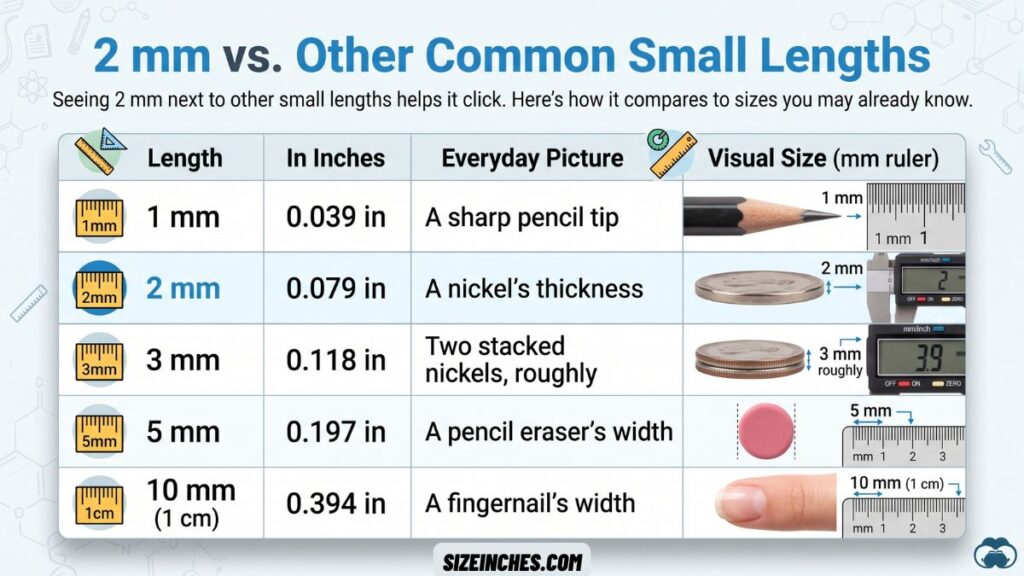
| Length | In Inches | Everyday Picture |
| 1 mm | 0.039 in | A sharp pencil tip |
| 2 mm | 0.079 in | A nickel’s thickness |
| 3 mm | 0.118 in | Two stacked nickels, roughly |
| 5 mm | 0.197 in | A pencil eraser’s width |
| 10 mm (1 cm) | 0.394 in | A fingernail’s width |
Two millimeters is double 1 mm, which is about a sharp pencil tip. It’s a bit more than half of 3 mm, and just one-fifth of 10 mm, which is a full centimeter. In inches, 2 mm is just over 1/16 of an inch. Keep those anchors in mind, and any small length from a pencil tip to a centimeter becomes easy to judge.
Frequently Asked Questions
How Much Is 2 mm Visually?
Two millimeters is about 0.079 inches, close to the thickness of a US nickel. It is small but easy to see with the naked eye.
What Does a 2mm Look Like?
2 mm looks like a nickel’s edge, a 2 mm pencil lead, or a grain of rice’s width. Two stacked credit cards come close too.
How Big Is 2 mm?
Two millimeters is about 0.079 inches, or just over 1/16 of an inch. That equals 0.2 cm, close to a nickel’s thickness.
How Can I Measure 2 mm?
Use a US nickel’s edge, which is almost exactly 2 mm. You can also stack two credit cards or count about 20 sheets of paper.
How Big Is a mm Visually?
One millimeter is about 0.039 inches, close to the tip of a sharp pencil. It is also about the thickness of a credit card.
Is 2 mm bigger than 1 cm?
No, 2 mm is much smaller than 1 cm. One centimeter equals 10 mm, so 2 mm is only one-fifth of a centimeter. In inches, 2 mm is about 0.079, while 1 cm is about 0.394. A centimeter is closer to a fingernail’s width, while 2 mm is a nickel’s thickness.
Conclusion
Now you know the 2 mm visual very well. Two millimeters equals about 0.079 inches. That is just over 1/16 of an inch. It is a small but visible length. A US nickel’s thickness is almost exactly 2 mm. A 2 mm pencil lead matches it perfectly too. These simple objects help you picture the length with ease.
You can also use other everyday things to check the size. A grain of rice is about 2 mm wide. Two credit cards stacked come close to the mark. A round toothpick is near 2 mm at its center. Keep these easy anchors in mind, and you will always sense the 2 mm visual.