
Standard Magazine Size – Dimensions in Inches, CM & Pixels
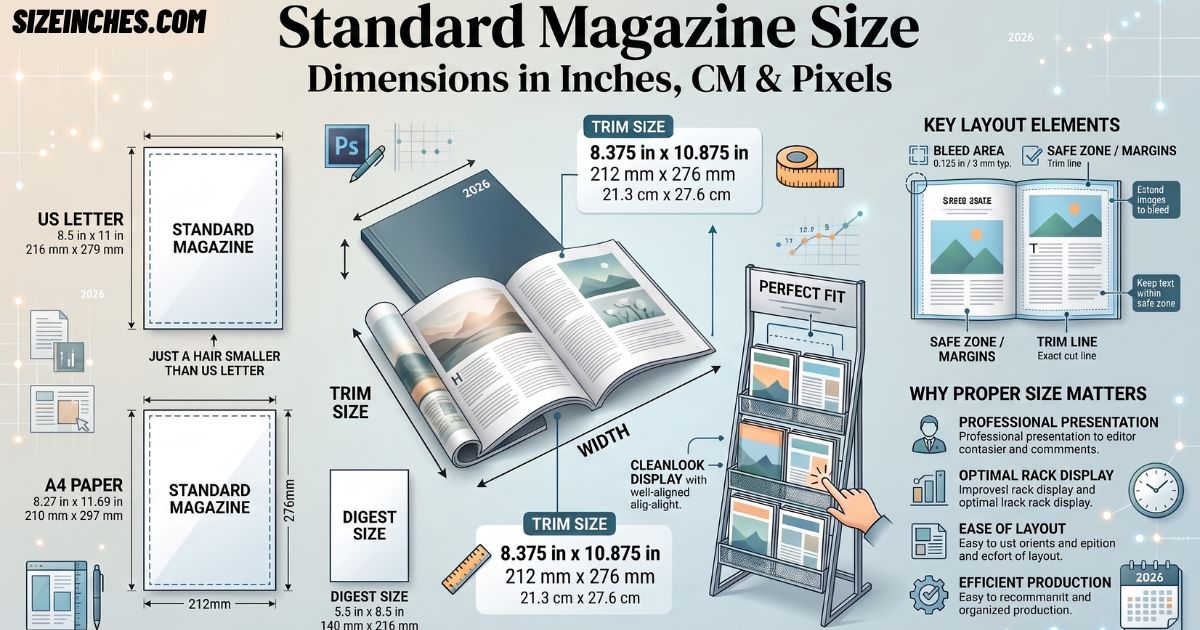
The term “standard magazine size” means the common trim size of a print magazine. It measures 8.375 by 10.875 inches, or 212 by 276 millimeters. That is the same as 21.3 by 27.6 centimeters, the size used on most newsstands.
Have you ever tried to design a magazine or plan a rack display? The right size makes everything fit and look clean. Once you know the exact numbers, you can lay out pages with ease.
A standard magazine is taller than it is wide. It is just a hair smaller than a sheet of US Letter paper. Other formats exist too, like the smaller digest size at 5.5 by 8.5 inches.
Standard Magazine Size in Different Units
A standard magazine measures 8.375 inches wide by 10.875 inches tall, which equals 212 by 276 millimeters. That’s the same as 21.3 by 27.6 centimeters. For print, designers add a bleed, making the working size a bit larger. Here’s the full breakdown so you can convert it fast.
| Measurement | Value | Notes |
| Width | 8.375 in / 212 mm | The trim width |
| Height | 10.875 in / 276 mm | The trim height |
| Width (cm) | 21.3 cm | Metric conversion |
| Height (cm) | 27.6 cm | Metric conversion |
| With bleed | 8.625 × 11.125 in | Add 0.125 in per edge |
| Pixels at 300 DPI | ~2,513 × 3,263 px | Print-quality resolution |
| Aspect ratio | ~1 : 1.3 | Taller than it is wide |
Quick Reference Table
Here are common objects and formats about the same size as a standard magazine, or close to it. Some match well, and some are a bit off. The table is honest about which is which.
| Item | Exact or Approx. | Visual / Notes | Best For |
| US Letter paper | 8.5 × 11 in | A hair bigger all around | Whole size |
| A4 paper | 8.27 × 11.69 in | Narrower but taller | Whole size |
| Spiral notebook | ~8 × 10.5 in | Very close | Whole size |
| Manila file folder | 8.5 × 11 in | Holds letter paper | Whole size |
| Legal pad | 8.5 × 11.75 in | A bit taller | Height |
| Large tablet (12.9 in) | ~8.5 × 11 in | An iPad Pro-size screen | Whole size |
| 13-inch laptop (closed) | ~8.5 × 12 in | A touch bigger | Rough size |
| Vinyl record sleeve | 12.4 × 12.4 in | Bigger and square | Contrast |
| Digest magazine | 5.5 × 8.5 in | Half the size | Contrast |
| Cereal box front | ~8 × 12 in | Close in width | Rough guide |
14 Everyday Things About the Size of a Standard Magazine
A Sheet of US Letter Paper
READ ALSO : What Size Is a Pokémon Card? Exact Dimensions
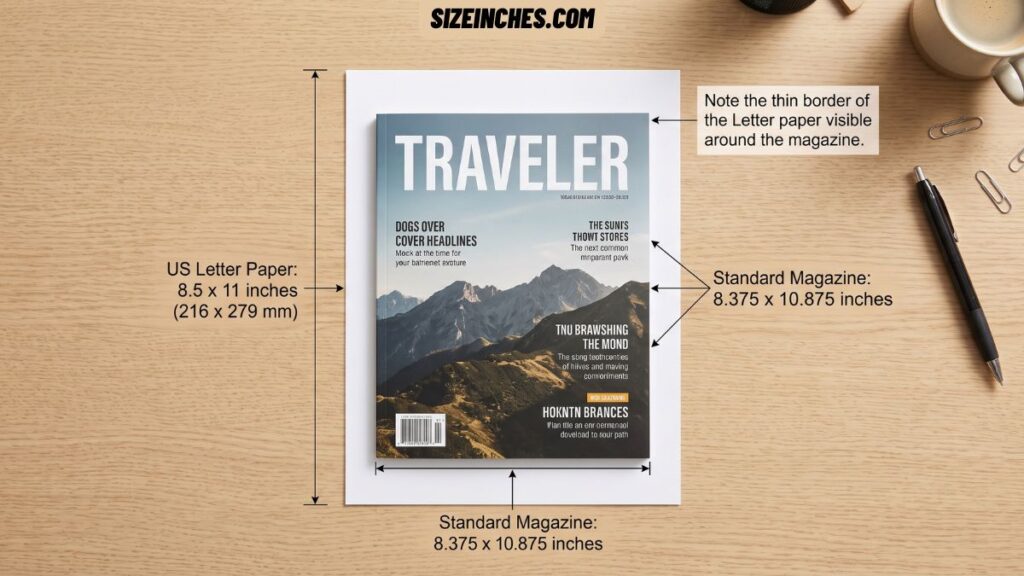
A sheet of US Letter paper is the closest everyday match to a standard magazine. Letter paper measures 8.5 by 11 inches (216 by 279 mm), just a hair bigger than the magazine’s 8.375 by 10.875 inches. Lay a magazine on a sheet of printer paper and you’ll see a thin border all around. If you can picture a sheet of paper, you already know the standard magazine size.
Letter paper is the everyday standard in the US and Canada, used in printers, notebooks, and copiers. It’s sold in reams of 500 sheets at any office store. The magazine is about an eighth of an inch narrower and shorter on each side. So a magazine fits neatly on a sheet of paper with a little room to spare. It’s the easiest size reference of all.
A Placemat
A standard placemat is close to the size of a magazine. Many rectangular placemats measure about 12 by 18 inches (305 by 457 mm), so they’re bigger than a magazine, while smaller ones run closer to the mark. A compact placemat near 9 by 12 inches sits right around the magazine’s footprint. Since placemats are in most kitchens, it’s an easy reference to grab.
Placemat size varies a lot by style, so treat this as approximate. Formal dinner placemats run large, while café-style ones are smaller. They’re made from fabric, plastic, cork, or bamboo, built to protect the table and catch spills. A smaller placemat is close to the magazine in width and length, while a large one runs bigger. A compact placemat gives you a rough, everyday feel for the standard magazine size.
A Cutting Board
READ ALSO : Jerry Can Sizes (2026): Every Size in Liters and Gallons
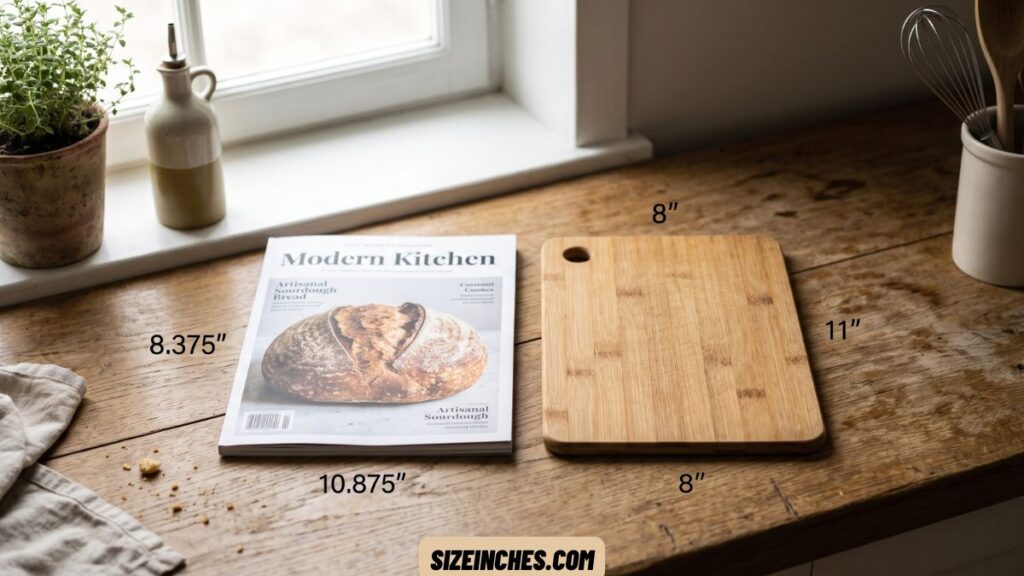
A small cutting board is close to the size of a magazine. Many compact boards measure about 8 by 11 inches (203 by 279 mm), right near the magazine’s 8.375 by 10.875 inches. Set a small board next to a magazine and the two nearly match. Since most kitchens have a cutting board, it’s a handy size reference to grab.
Cutting board size varies widely, so treat this as approximate. A tiny prep board is smaller, while a large carving board runs much bigger. They’re made from wood, plastic, or bamboo, built to protect knives and counters. A small board is close to the magazine in both width and length, making it a good everyday match. A compact cutting board gives you a close feel for the standard magazine size.
A Clipboard

A standard clipboard is close to the size of a magazine. A letter-size clipboard measures about 9 by 12.5 inches (229 by 318 mm), a bit bigger than the magazine, especially in length. Set a magazine on a clipboard and it fits with room around the edges. Since clipboards are in many offices and homes, it’s an easy size reference.
Clipboards are built to hold letter paper, which is why they run just larger than a magazine. They’re made from hardboard, plastic, or metal, with a spring clip at the top to grip pages. The clipboard is about half an inch wider and over an inch longer than the magazine. So a magazine sits neatly on a clipboard with a small border. It gives you a close, everyday guide for the magazine size.
A Vinyl Record Inner Booklet
A record booklet or gatefold panel is close to a magazine in one dimension. A single panel of an album gatefold measures about 12 by 12 inches (305 by 305 mm), so it’s square and wider than a tall magazine. Set the two together and the panel is wider but similar in height. It’s a fun reference for music fans who keep vinyl around.
Record art panels are printed on heavy card stock, often with lyrics, photos, or credits inside a gatefold sleeve. The magazine is about 3.5 inches narrower than a record panel but close in height. So the two share a rough height but differ in width and shape. A record gatefold panel gives you a rough sense of the magazine’s height, though its square shape sets it apart.
A Comic Book
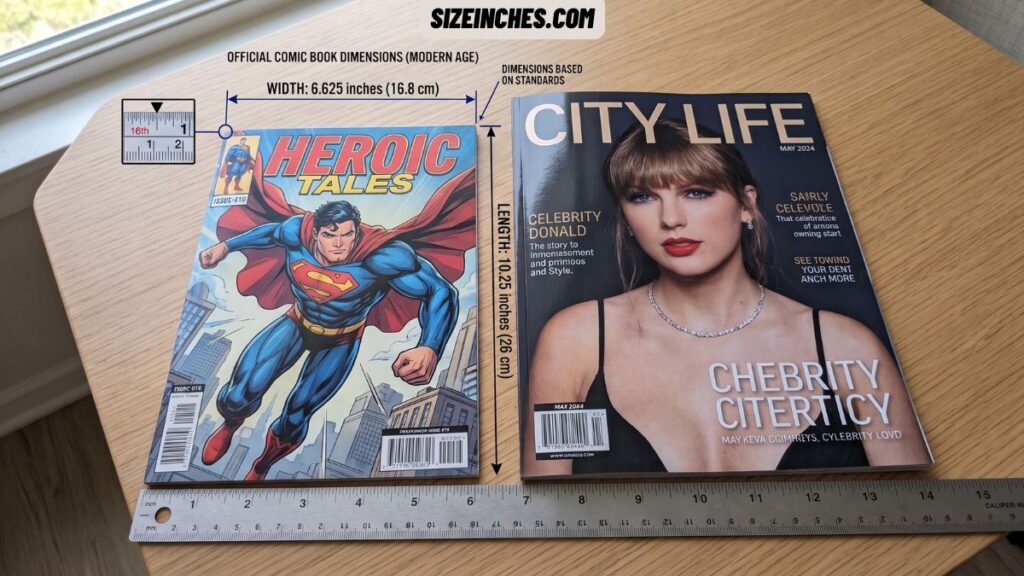
A comic book is a useful contrast to a standard magazine. A modern comic measures about 6.625 by 10.25 inches (168 by 260 mm), so it’s narrower and a touch shorter than a magazine. Set the two together and the comic is slimmer, while the magazine is wider and a bit taller. Since many people have comics around, it’s an easy reference.
Comic book size has shrunk a little over the decades, settling at the current standard. They’re printed on glossy or matte paper with a card cover, built for reading and collecting. The magazine is about 1.75 inches wider and a bit taller than a comic. So comics use their own bags and boards, not magazine ones. Picturing a comic helps you see how a standard magazine is wider and larger.
A Placemat-Size Desk Calendar
A desk pad calendar is close to a magazine in width but often bigger overall. A compact desk calendar measures about 9 by 11 inches (229 by 279 mm), right near the magazine’s footprint, while large blotter styles run much bigger. Set a small desk calendar next to a magazine and the two nearly match. Since calendars are on many desks, it’s a handy reference.
Desk calendar size varies a lot by style, so treat this as approximate. A monthly tear-off pad is compact, while a full desk blotter can span the whole desktop. They’re made from paper pages on a card backing, sometimes with a stand. A small desk calendar is close to the magazine in both width and length. A compact desk calendar gives you a close, everyday feel for the standard magazine size.
A Sheet of A4 Paper
A sheet of A4 paper is a close match to a standard magazine. A4 measures 8.27 by 11.69 inches (210 by 297 mm), so it’s a touch narrower but noticeably taller than the magazine. Set the two together and the A4 sheet is slimmer yet runs longer at the top. It’s the paper standard across most of the world outside North America.
A4 is part of the international ISO paper system, where each size folds neatly into the next. It’s used in printers and offices across Europe, Asia, and beyond. The magazine is about a tenth of an inch wider than A4 but nearly an inch shorter. So the two are close but not identical. An A4 sheet gives you a good size reference, especially outside the US.
A Standard Spiral Notebook
A standard spiral notebook is close to the size of a magazine. Many notebooks measure about 8 by 10.5 inches (203 by 267 mm), right near the magazine’s 8.375 by 10.875 inches. Set a notebook next to a magazine and the two nearly match, with the magazine a touch bigger. Since notebooks are in most homes and bags, it’s an easy reference to grab.
Notebook size varies a little by brand, so treat this as close but approximate. Some run exactly letter-size at 8.5 by 11 inches, while others are a bit smaller. The spiral binding lets pages lie flat or fold all the way back. They’re made from ruled paper with a card or poly cover. A standard spiral notebook gives you a close, everyday feel for the standard magazine size.
A Manila File Folder
A manila file folder is close to the size of a magazine. A letter-size folder measures about 8.5 by 11 inches (216 by 279 mm) when closed, just a bit bigger than the magazine. Slide a magazine into a folder and it fits with room to spare. Since folders are in most offices and homes, it’s a handy size reference.
File folders are built to hold letter paper, which is why they run just larger than a magazine. They’re made from stiff manila card stock with a tab for labeling. The folder is about an eighth of an inch bigger than the magazine on the width and a bit taller. So a magazine tucks neatly inside a standard folder. It gives you a close, everyday guide for the magazine size.
A Legal Pad
A legal pad is close to a magazine in width but a bit taller. A standard legal pad measures about 8.5 by 11.75 inches (216 by 298 mm), so it shares a similar width but runs almost an inch longer than the magazine. Set the two side by side and the pad sticks out at the top. It’s a common desk item, so it’s easy to grab for a size check.
Legal pads come in letter and legal lengths, so this one is approximate. The classic yellow pad has a ruled writing area with a wider top margin line. They’re made from ruled paper glued at the top, with a stiff cardboard backing. The magazine is a little shorter than a legal pad but close in width. A legal pad gives you a handy frame for picturing the magazine size.
A Large Tablet
A large tablet is close to the size of a magazine. A 12.9-inch tablet, like an iPad Pro, measures about 8.5 by 11 inches (216 by 280 mm) for the whole device, right near the magazine’s size. Hold a big tablet next to a magazine and the two nearly match. Since so many people own a tablet, it’s a handy modern reference.
Tablet size varies by model, so this one is approximate. Smaller tablets are well under magazine size, so a large 12.9-inch model is the better match here. Tablets pack a screen, battery, and computer chip into a thin frame of glass and metal. Many people read digital magazines on them, so the size link makes sense. A large tablet gives you a close, everyday feel for the standard magazine size.
A 13-Inch Laptop
A 13-inch laptop is close to a magazine in size when closed. A typical one measures about 8.5 by 12 inches (216 by 305 mm), a touch bigger than the magazine, especially in length. Set a closed laptop next to a magazine and the laptop is a little larger all around. Since laptops are so common, it’s an easy reference to grab.
Laptop size varies by brand and model, so treat this as approximate. A 13-inch screen is measured on the diagonal, while the body is a bit larger. The closed laptop is a flat rectangle of metal or plastic, close to the magazine’s footprint. It’s about an inch longer than the magazine but similar in width. A 13-inch laptop gives you a rough, everyday guide for the magazine size.
A Vinyl Record Sleeve
A vinyl record sleeve is a useful contrast to a magazine. An LP record cover measures 12.375 by 12.375 inches (314 by 314 mm), so it’s bigger than a magazine and square instead of tall. Set the two together and the record sleeve is wider, longer, and evenly square, while the magazine is taller than it is wide.
Record sleeves are built to hold a 12-inch vinyl LP, with a little extra room. They’re made from thick cardboard, often with printed cover art. The magazine is about 4 inches narrower and 1.5 inches shorter than a record sleeve. So they need different storage and display. Picturing a record sleeve helps you see just how much smaller and taller a standard magazine really is.
How to Picture a Standard Magazine Size Without a Ruler
No ruler nearby? These tricks use common paper and your own hands to check a magazine’s size.
Compare It to a Sheet of Paper
This is the easiest method. Grab a sheet of US Letter paper, which measures 8.5 by 11 inches. A standard magazine is just a hair smaller, so it fits on the paper with a thin border all around. If a magazine sits neatly on a sheet of paper with a little room to spare, you’ve confirmed the standard magazine size with no ruler.
Use Your Hand Span
Most adults have a hand span of about 8 to 9 inches, measured from the thumb tip to the pinky tip when spread wide. So a standard magazine is about one hand span wide and a bit over one span tall. Measure your own span once against a ruler, and you’ll always carry a rough magazine-size guide with you.
Fold a Sheet of Paper
You can use folds to check the height too. A sheet of Letter paper is 11 inches long, and a magazine is 10.875 inches tall, almost the same. For the digest size, fold a sheet of Letter paper in half. Each half is about 5.5 by 8.5 inches, which matches a digest magazine closely. Folding paper is a quick way to picture the smaller formats.
Standard Magazine Size vs. Other Print Sizes
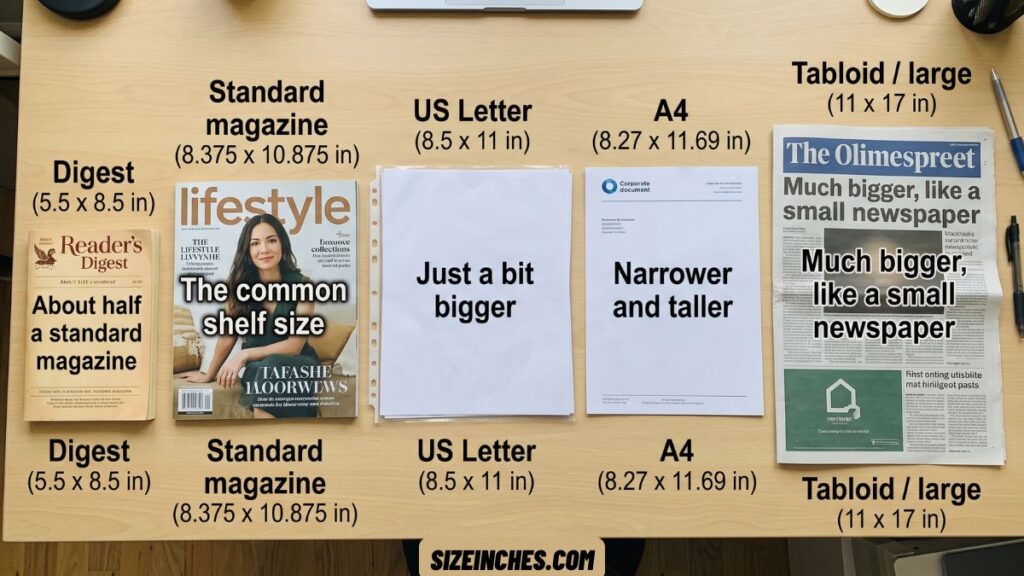
Seeing a standard magazine next to other print sizes helps it click. Here’s how it compares to formats you may already know.
| Format | Size | Notes |
| Digest | 5.5 × 8.5 in | About half a standard magazine |
| Standard magazine | 8.375 × 10.875 in | The common shelf size |
| US Letter | 8.5 × 11 in | Just a bit bigger |
| A4 | 8.27 × 11.69 in | Narrower and taller |
| Tabloid / large | 11 × 17 in | Much bigger, like a small newspaper |
A standard magazine is about twice the size of a digest magazine, like Reader’s Digest. It’s just a touch smaller than a sheet of US Letter paper, and close to A4 in size. A tabloid format is far bigger, closer to a small newspaper. Most consumer magazines you see on a rack use the standard size or something very near it. Keep those anchors in mind, and any print size becomes easy to judge.
Frequently Asked Questions
The standard magazine size is 8.375 by 10.875 inches, or 212 by 276 mm. That equals 21.3 by 27.6 cm, used on most newsstands.
Are Magazines A3 or A4?
Neither exactly, but magazines are close to A4. A standard magazine is a bit wider and shorter than A4, which is 21 by 29.7 cm.
Is Vogue Magazine A4 Size?
Not exactly. Vogue is close to A4 but uses its own trim, near the standard 8.375 by 10.875 inches. It is a bit wider and shorter than A4.
Are Standard Magazines A4?
No, but they are close. A standard magazine is 8.375 by 10.875 inches, while A4 is 8.27 by 11.69 inches, so it is narrower and taller.
What Is A1, A2, A3, and A4 in cm?
A1 is 59.4 by 84.1 cm, A2 is 42 by 59.4 cm, A3 is 29.7 by 42 cm, and A4 is 21 by 29.7 cm.
Are all magazines the same size?
No, magazines come in several sizes. The standard is 8.375 by 10.875 inches, but digest magazines are about 5.5 by 8.5 inches, and some large-format titles run bigger. Trade and fashion magazines sometimes use their own sizes. Still, the standard size covers the majority of magazines on shelves.
Conclusion
Now you know the standard magazine size very well. It measures 8.375 by 10.875 inches, or 212 by 276 millimeters. That is the same as 21.3 by 27.6 centimeters. Most consumer magazines on the rack use this trim size. The magazine is taller than it is wide. A sheet of US Letter paper is just a hair bigger.
You can also use everyday things to picture the size. A sheet of A4 paper is narrower but taller than a magazine. A spiral notebook lands right in the same range. A small cutting board matches the footprint closely too. Keep these easy anchors in mind, and you will always know the standard magazine size.



2 Comments